
Mangrove Restoration
Sundari Details
Restoring Mangroves. Strengthening Communities. Building Climate Resilience.
The Sundari Mangrove Restoration Project is a large-scale nature-based climate initiative working to restore degraded mangrove ecosystems across the Indian Sundarbans in West Bengal.
About Project Sundari
Restoring One of the World’s Most Important Coastal Ecosystems
The Sundarbans is a landscape shaped by water, tides and people. Its mangrove forests protect coastal communities from cyclones and storm surges, provide habitat for exceptional biodiversity and support livelihoods linked to fishing, honey collection and other natural resources.
Yet this fragile ecosystem faces increasing pressure from climate change, salinity, erosion, extreme weather events and the degradation of mangrove habitats.
The Sundari Project responds to these challenges through a long-term, science-based restoration programme focused on rehabilitating degraded areas with native mangrove species, strengthening natural coastal defences and building greater resilience among communities living in one of India’s most climate-vulnerable regions.
South 24 Parganas
Restoring coastal mangrove ecosystems
Purpose
To restore, protect and sustainably manage degraded mangrove ecosystems in the Sundarbans to:
- Enhance carbon sequestration
- Strengthen climate resilience
- Promote biodiversity conservation
- Improve community livelihoods
Geographic Focus
- Region: Sundarbans
- District: South 24 Parganas, West Bengal, India
- Target Restoration Area: 4,500 hectares
- Species: 19 native mangrove species, particularly Avicennia Sp., Rhizophora Sp., Bruguiera Sp.
Specific Objectives
- 1Rehabilitate degraded mangrove zones using native species and ecological restoration techniques.
- 2Actively engage local communities through Local Stakeholders Consultancy and implementation.
- 3Monitor project areas on key ecological metrics: forest health, biodiversity and carbon capture.
- 4Raise awareness on mangrove conservation.
- 5Align restoration efforts with local and national climate and environmental policies.
Our Vision
A Resilient Sundarbans Where Nature and Communities Thrive Together
Project Sundari seeks to demonstrate that ecological restoration can achieve more than planting trees. The project is designed to:
- Restore degraded mangrove ecosystems
- Increase long-term carbon sequestration
- Strengthen resilience against erosion, cyclones and storm surges
- Protect and enhance biodiversity
- Create local employment and livelihood opportunities
- Strengthen community ownership of restoration activities
- Use climate and carbon finance to support long-term environmental and social outcomes
.jpeg)
Our Impact
Restoration at Landscape Scale across the Indian Sundarbans
1,000 Hectares Restored
Restoration at Landscape Scale
Mangrove restoration activities have already covered 438 hectares across project locations in the Indian Sundarbans, with a long-term target restoration area of 4,500 hectares across degraded mangrove ecosystems.
3 Million+ Saplings Planted
Growing Coastal Defences
More than 1.2 million mangrove saplings have been planted as part of the restoration programme, contributing toward a 3.0 million+ planting ambition across project sites.
90% Survival Rate
Science-Backed Stewardship
The project reports a 90% mangrove survival rate, supported by nursery development, site assessment, field monitoring and replantation where required.
11 Mangrove Nurseries
Propagation Network
A network of 11 nurseries supports the propagation and development of healthy mangrove saplings before transplantation. The nurseries also provide a reserve for replantation following damage caused by natural events.
Current nursery locations identified in the project documentation include:
Where We Work
Across the Indian Sundarbans
In Project Sundari, there are 11 administrative blocks, enabling the project to work across diverse ecological and community landscapes. The scale of the project enables restoration planning to move beyond isolated plantation sites towards a broader landscape-based approach to mangrove recovery and climate resilience.
Project Blocks
Why Mangroves Matter
Nature's Coastal Defence
Mangroves are among the world’s most valuable ecosystems. Their benefits extend from climate mitigation to coastal protection and livelihood security.
Carbon Sequestration
Mangrove ecosystems store significant quantities of carbon in their vegetation and carbon-rich soils, making their protection and restoration an important nature-based climate solution.
Coastal Protection
Mangroves act as natural buffers against storm surges, cyclones, coastal erosion and tidal impacts.
Biodiversity
Mangrove ecosystems support diverse terrestrial and aquatic species and provide important habitat across the wider Sundarbans landscape.
Fisheries and Marine Productivity
Mangrove areas function as breeding, feeding and nursery grounds for fish, crabs, shrimp and other aquatic species that support local livelihoods.
Community Resilience
Healthy mangrove ecosystems strengthen the ability of vulnerable coastal communities to adapt to environmental and climate-related risks.
Our Restoration Approach
From Satellite Mapping to Long-Term Monitoring
Project Sundari follows a structured implementation framework designed to combine scientific planning with local knowledge and community participation.
Site Identification
Satellite imagery, remote sensing and GIS tools are used to identify potential restoration areas. The project uses Land Use Land Cover analysis; Normalised Difference Vegetation Index assessment; geospatial mapping; and Kobo-based field verification.
Ground Truthing and Ecological Assessment
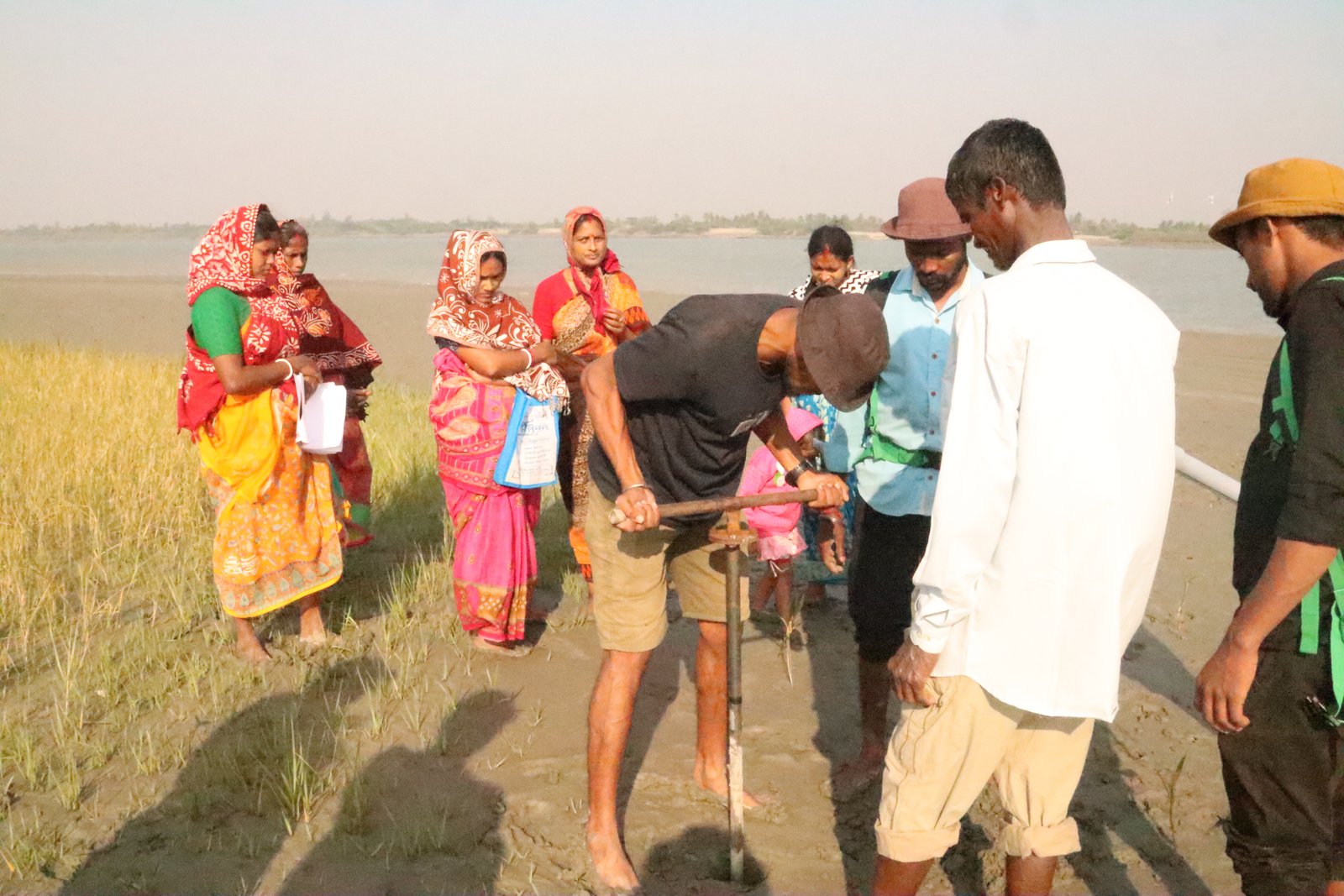
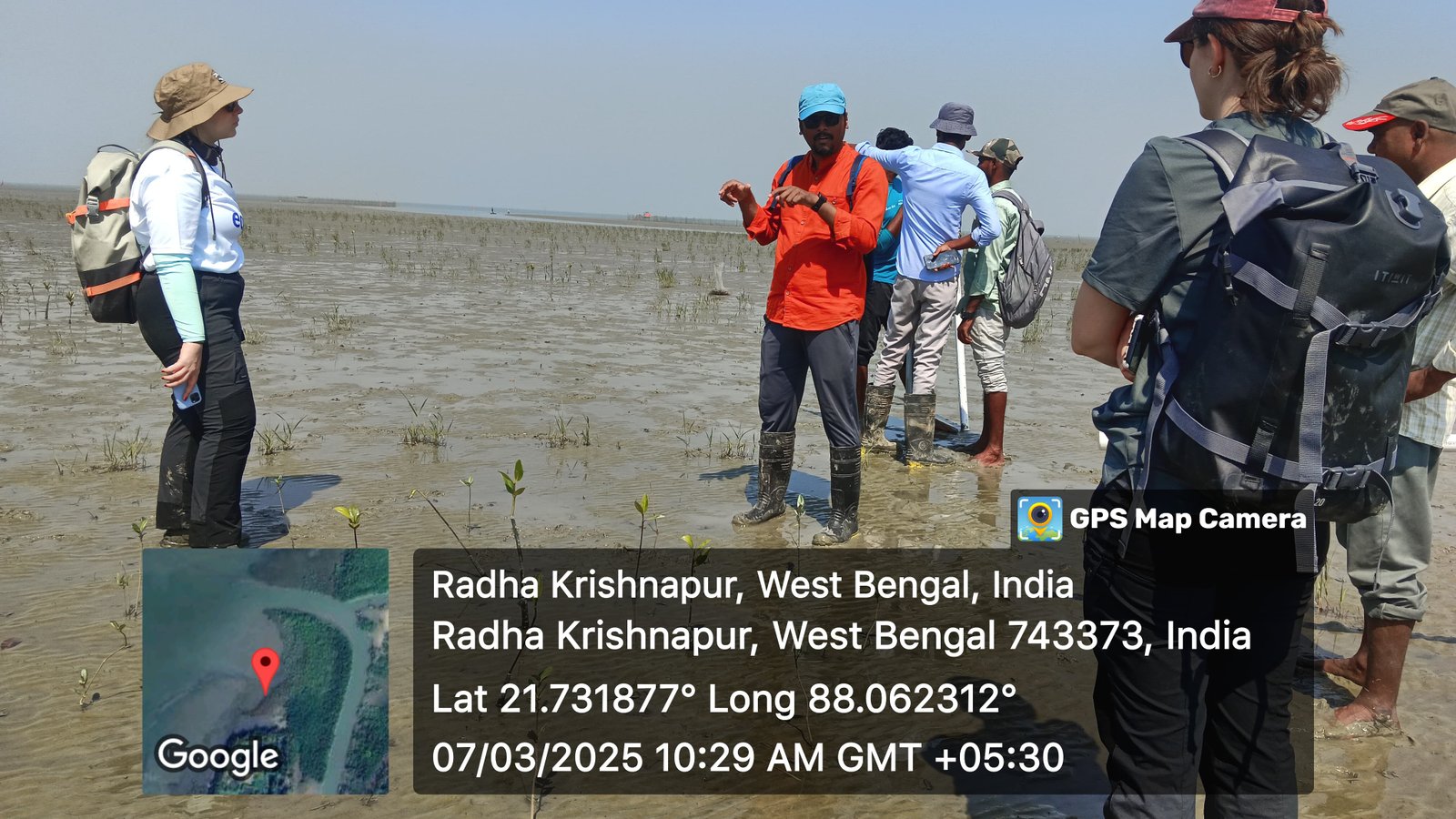
Potential restoration sites are assessed on the ground by field teams and ecological experts. This includes soil assessment; water quality analysis; physicochemical measurements; ecological observations; and site suitability evaluation.
Panchayat Engagement
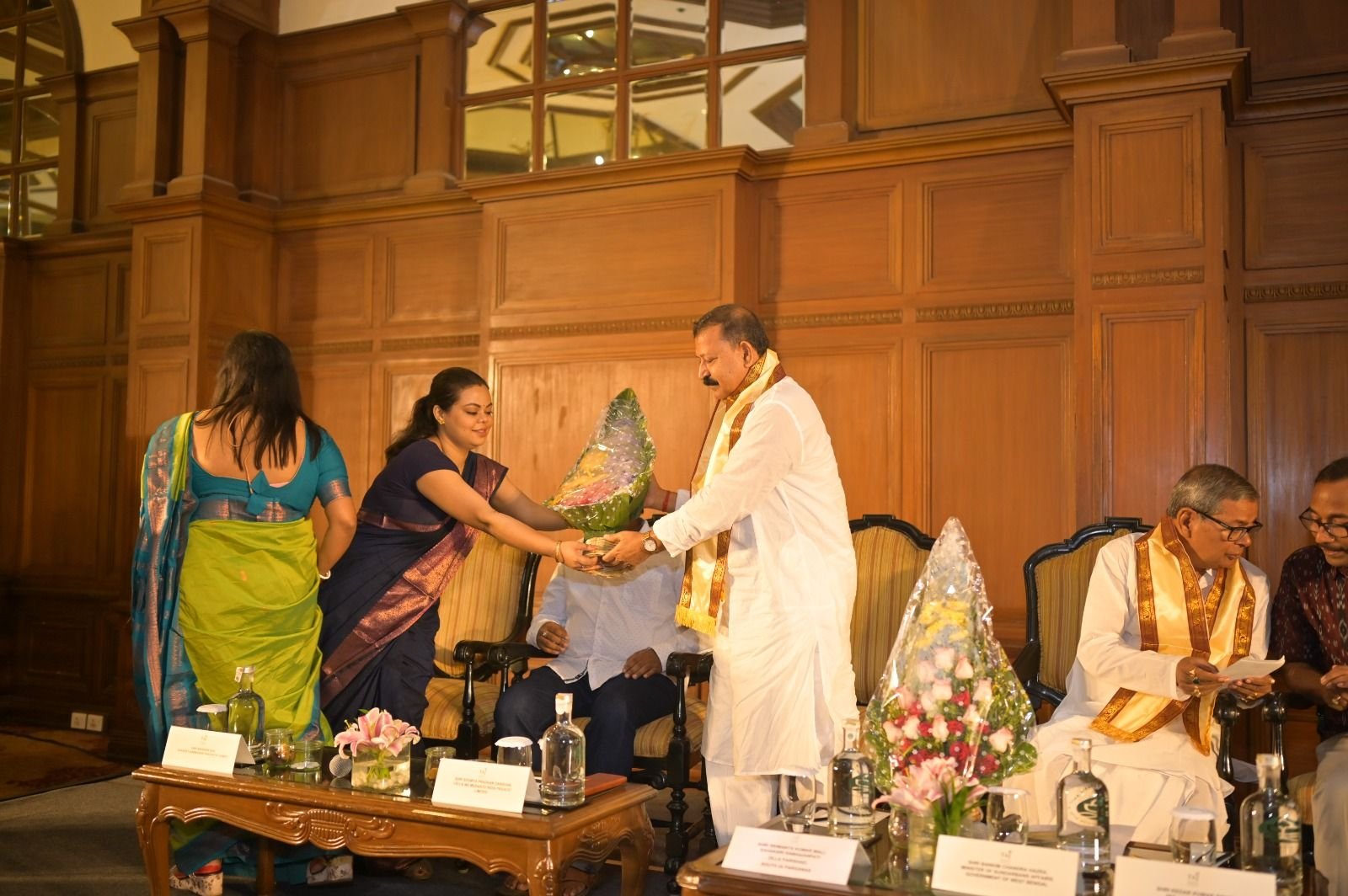
The project engages with Gram Panchayats and local governance institutions to introduce the restoration programme and develop local cooperation.
Local Stakeholder Consultation
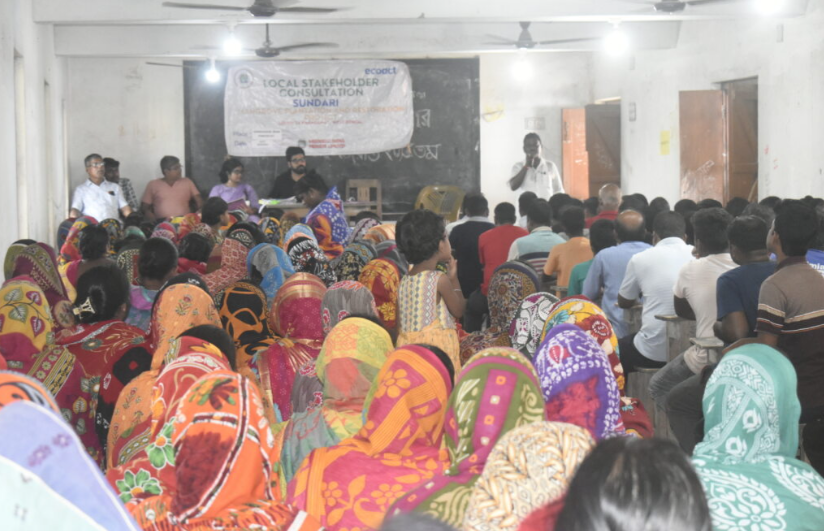
Community-level consultations are organised to explain the project; understand local environmental and livelihood concerns; gather community feedback; identify potential restoration opportunities; and support participatory planning.
Formal Engagement
Project participation is formalised through appropriate Letters of Engagement or cooperation arrangements with participating Panchayats.
Nursery Establishment
Mangrove nurseries are developed in selected locations, with local communities participating in nursery operations and sapling preparation.
Plantation
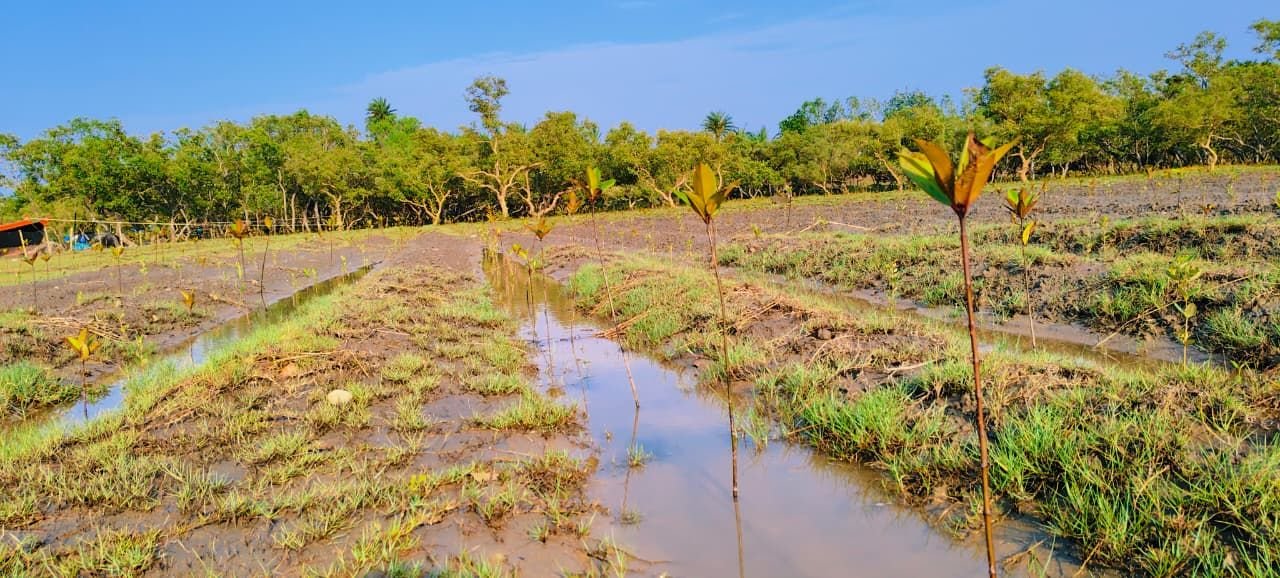
Native mangrove species are planted in ecologically suitable areas based on site-specific conditions.
Monitoring and Replantation
Plantation areas are continuously monitored using a combination of field inspections, digital applications, geospatial tools and ecological measurements. Replantation is undertaken where necessary.
Long-Term Community Benefit
The project seeks to link restoration outcomes with community development through employment, capacity building and a participatory Benefit Sharing Mechanism.
The Sundari Mangrove Restoration Project uses digital tools, scientific equipment and trained field teams to ensure accurate monitoring, data collection and restoration planning.
Science and Technology
Data-Driven Restoration
Project Sundari combines field knowledge with digital technology and scientific monitoring to improve the quality, transparency and accountability of restoration activities.
Centralised Digital Dashboard
- Real-time field data uploads
- Tracking of plantation and restoration metrics
- Monitoring of species survival and canopy development
- Generation of analytical reports
Kobo Toolbox
- Pre-restoration site assessment
- Collection of ecological and social baseline data
- Creation of monitoring plots
- Field-level resource planning
Scientific Field Equipment
- 6-in-1 water quality checkers
- Soil augers
- GPS units
- Tree height and girth measuring devices
- Transect and monitoring tools
- Sampling equipment
- Laboratory drying ovens
Parameters assessed include
This integrated system supports scientifically robust and verifiable monitoring from site identification through long-term restoration management.
Community at the Centre
Restoration Led from the Ground
The Sundari Project is built on the principle that long-term ecological restoration requires long-term community participation. Local communities are engaged in:
- Nursery establishment and management
- Preparation and care of mangrove saplings
- Plantation activities
- Monitoring and maintenance
- Ecological awareness
- Local stakeholder consultations
- Development of community benefit initiatives
The project reports that 80% of plantation participation is by women, demonstrating the central role of women in delivering restoration activities across project sites.
Climate and Carbon Framework
Financing Long-Term Restoration
Project Sundari is being developed within a carbon finance framework intended to support the long-term sustainability of mangrove restoration activities.
- Carbon Standard: Verified Carbon Standard (VCS)
- Methodology: VM0033 — Tidal Wetland and Seagrass Restoration
- Long-Term Project Horizon: 20 years
The project combines ecological restoration with monitoring, community engagement and long-term stewardship to create a model through which climate finance can support both environmental recovery and local resilience.
Alignment with Sustainable Development Goals (SDGs)
This project directly supports several UN Sustainable Development Goals, including:
SDG 1: No Poverty
through job creation and income generation
SDG 5: Gender Equality
by empowering women in restoration work
SDG 13: Climate Action
via carbon sequestration and climate resilience
SDG 14: Life Below Water
by protecting coastal ecosystems
SDG 15: Life on Land
through biodiversity conservation
SDG 17: Partnerships for the Goals
via collaboration with local, national and international partners
Our Field Presence
Local Infrastructure for Long-Term Delivery
Project Sundari maintains a growing field presence to support implementation, monitoring and community coordination — 1 main office in Kolkata and 4 field offices.
These offices support:
- Field coordination
- Nursery supervision
- Ecological monitoring
- Community engagement
- Documentation
- Data management
- Project implementation
Restoring More Than Mangroves
Project Sundari is creating a model of restoration in which ecological science, community participation and technology work together.
Every nursery strengthens local capacity. Every sapling contributes to a more resilient coastline. Every restored hectare supports biodiversity and climate action. Every community partnership helps build lasting stewardship.
Project Sundari is not only restoring mangroves. It is helping build a more resilient future for the Sundarbans and the communities that call it home.
Press & Public Mentions
Workshops, newsletters and national media coverage of Project Sundari.
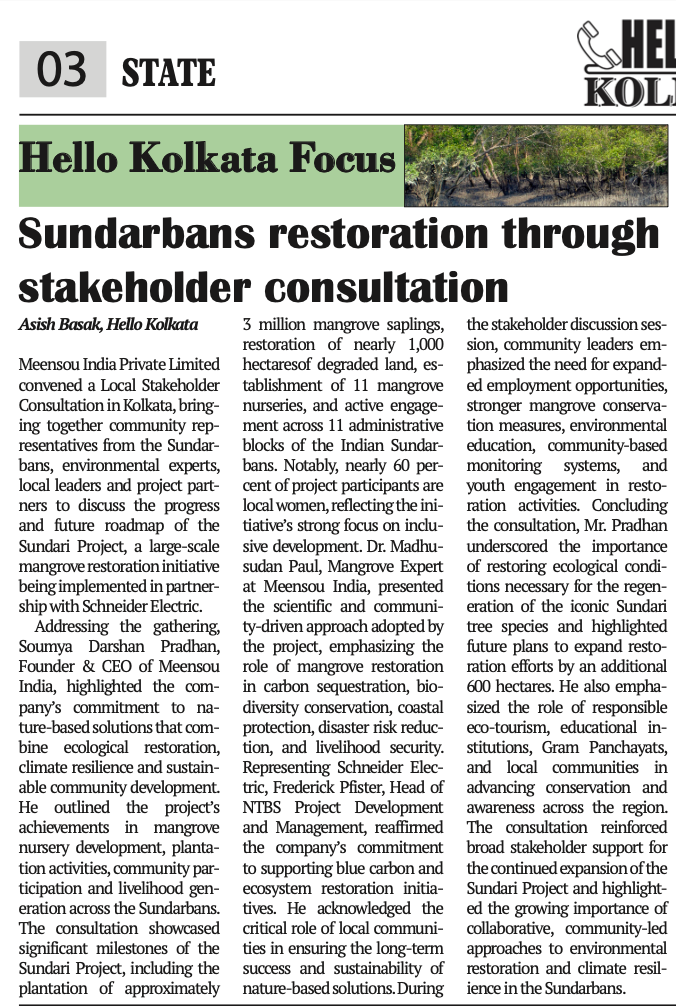
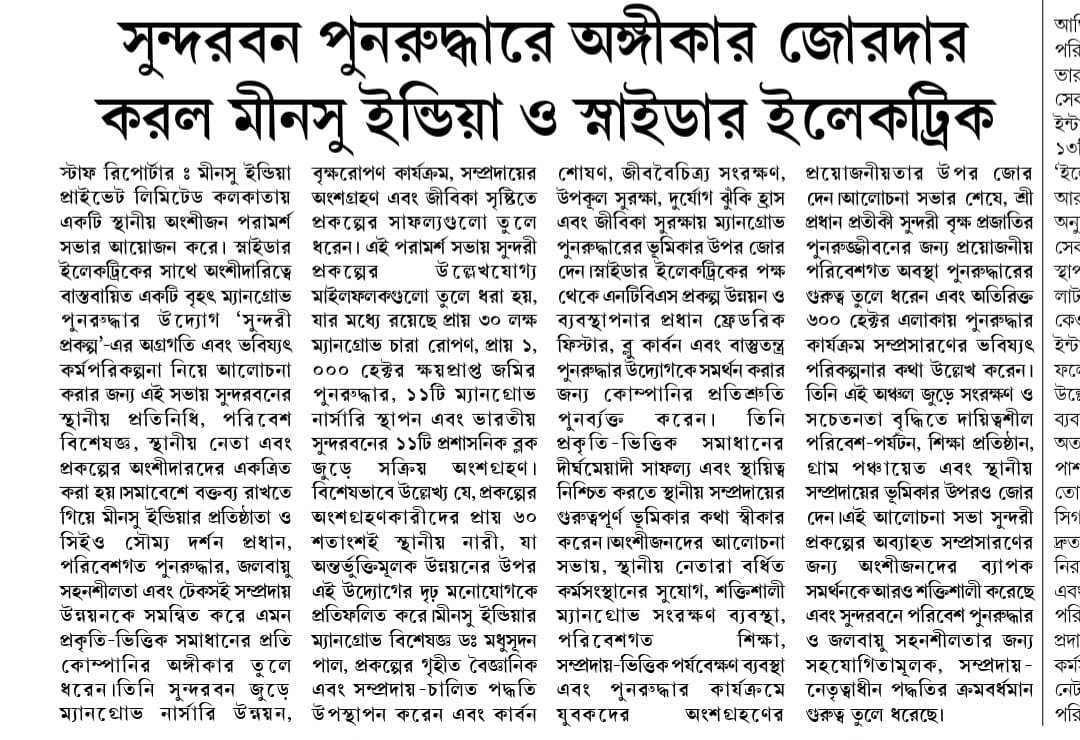
Newspaper Clippings
Print coverage of Project Sundari stakeholder consultations and restoration progress
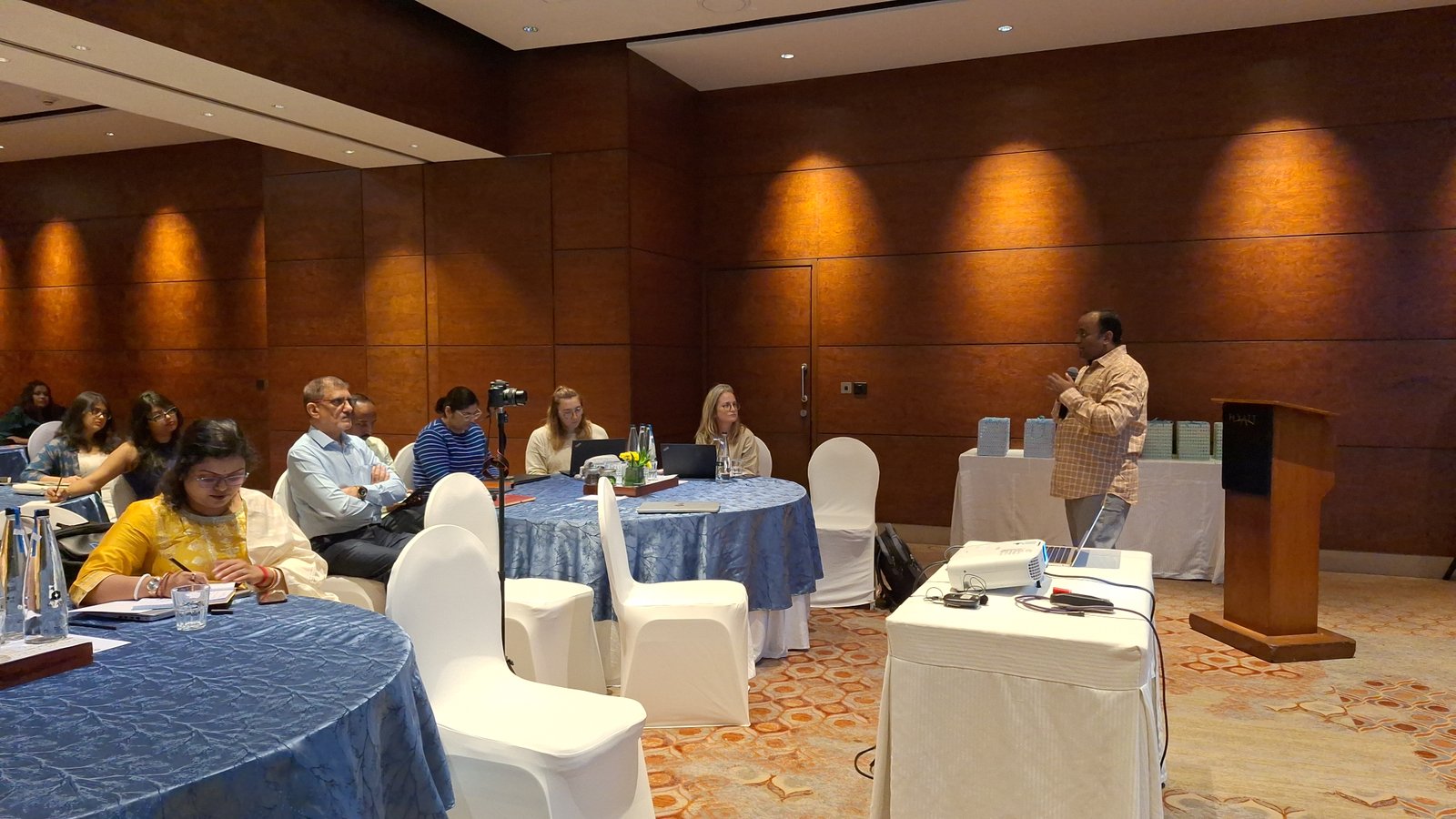
BCCI – Meensou Workshop
Decarbonisation engagement with The Bengal Chamber of Commerce & Industry
EcoAct November Visit
National coverage of Project Sundari’s 4,500 hectare target restoration area ambition
Project taken up to restore 4,500 hectares of degraded mangroves in Sundarbans
Read articlePrivate sector-backed project to restore 4,500 hectares of degraded mangroves in Sundarbans
Read articleDaily Pioneer – Dehradun English Edition
Open PDFEcoAct November Visit – Video
WatchProject Gallery
Sundari field work and community drives, plus Project Koshal and Utkal Uday landscapes across Odisha.
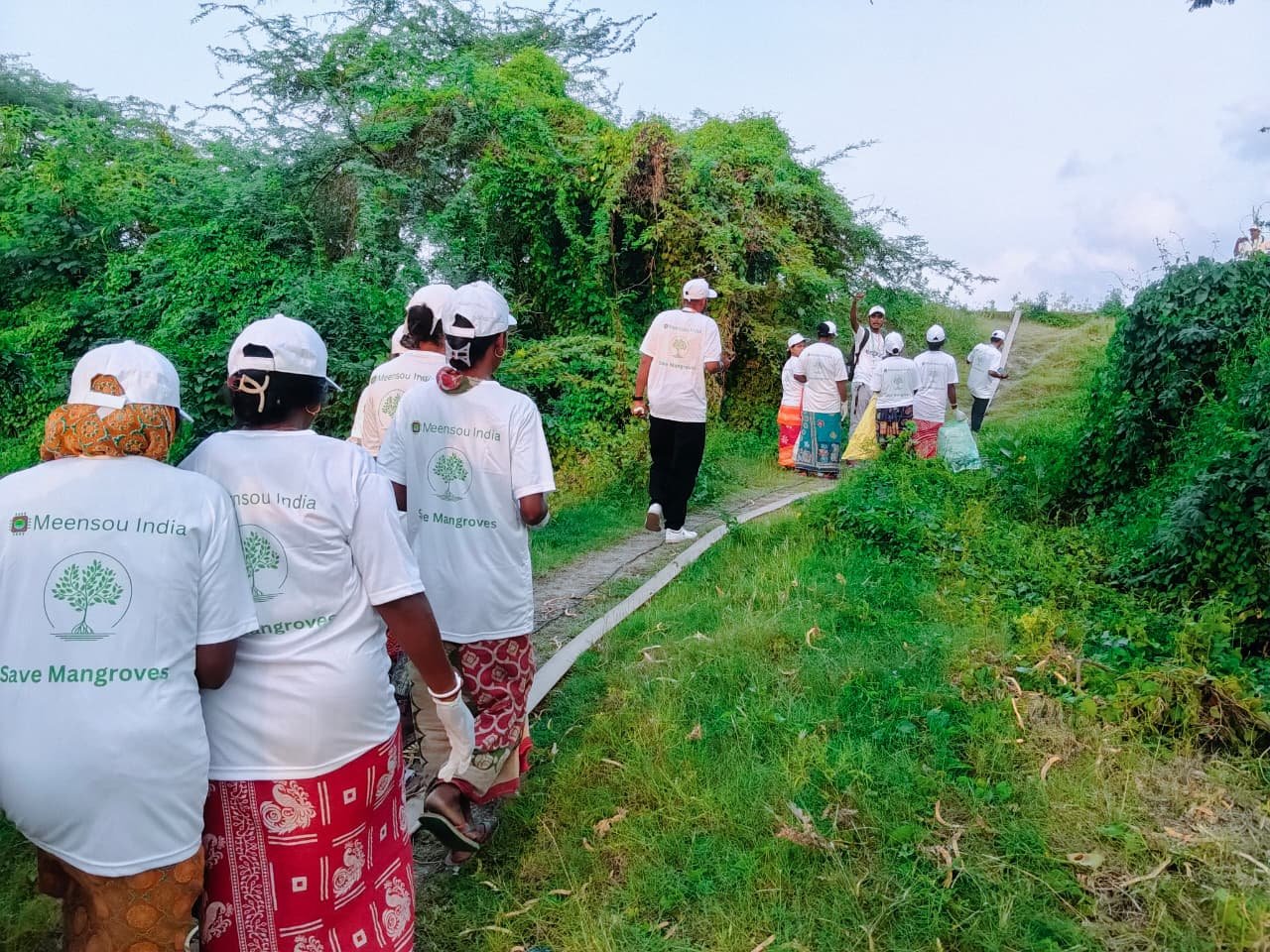
Cleanliness Drive — Meensou
Community cleanliness drives organized by Meensou in Sundarbans villages.
Field & Community
On-ground field work and direct community engagement across project sites.
Field Visits by Team
Meensou team conducting field visits and site assessments in the delta.
Project Koshal
Landscapes and project sites across the Koshal region of Odisha.
Kolkata Stakeholder Consultation 2024
Kolkata Local Stakeholder Consultation sessions held in 2024.
Sundarban Stakeholder Consultation 2025
Sundarban LSC meetings and consultations conducted in 2025.
Sundarban Stakeholder Consultation 2026
Sundarban LSC meetings and consultations conducted in 2026.
Mangrove Training Program 2024
Mangrove plantation and nursery training programs for local communities.
Mangrove Workshop 2025
Mangrove conservation workshops and capacity-building sessions.
Field Monitoring
Field-level monitoring of mangrove plantations and project progress.
Namkhana Office Monitoring
Monitoring activities at the Namkhana project office.
Newspaper Coverage
Print media coverage of Project Sundari — Hello Kolkata and Bengali newspaper clippings.
Team Meetings
Internal team coordination and planning meetings for the Sundari project.
Project Utkal Uday
District landscapes and project coverage under Meensou’s Utkal Uday initiative.